In this episode of Demand Gen Studio, we discussed how to set up effective Google Ad campaigns for B2B companies. We explore the fundamental differences between B2B and B2C advertising, including the importance of understanding the unique challenges and opportunities within the B2B space.
The discussion covers key strategies for campaign setup, how to align your offer, messaging, and audience targeting to optimize ad performance, and other practical tips for marketers looking to enhance their Google Ads strategies in the B2B sector.
For a real-world example, see how Boundify helped a event production company with google ads.
Watch on Spotify
Watch on YouTube
Google Ads for B2B vs B2C
In B2B, Google Ads operates on a fundamentally different playing field than B2C, and recognizing those differences is essential to driving real pipeline impact.
While Google’s platform is built to reward the speed, volume, and trackability of B2C transactions, B2B marketers face lower search volume, longer sales cycles, and conversions that happen far beyond the ad platform.
Because Google offers almost no firmographic insight, unlike LinkedIn, B2B success depends on interpreting intent from search terms alone and continuously refining campaigns to filter out residential or consumer-oriented traffic.
With the high cost of sales teams engaging unqualified leads, the margin for false positives is much smaller in B2B. That means tighter exclusions, smarter intent modeling, and an ongoing balance between generating opportunities and ensuring they’re the right fit.
Ultimately, effective B2B Google Ads isn’t just at campaign setup, but ongoing optimization.
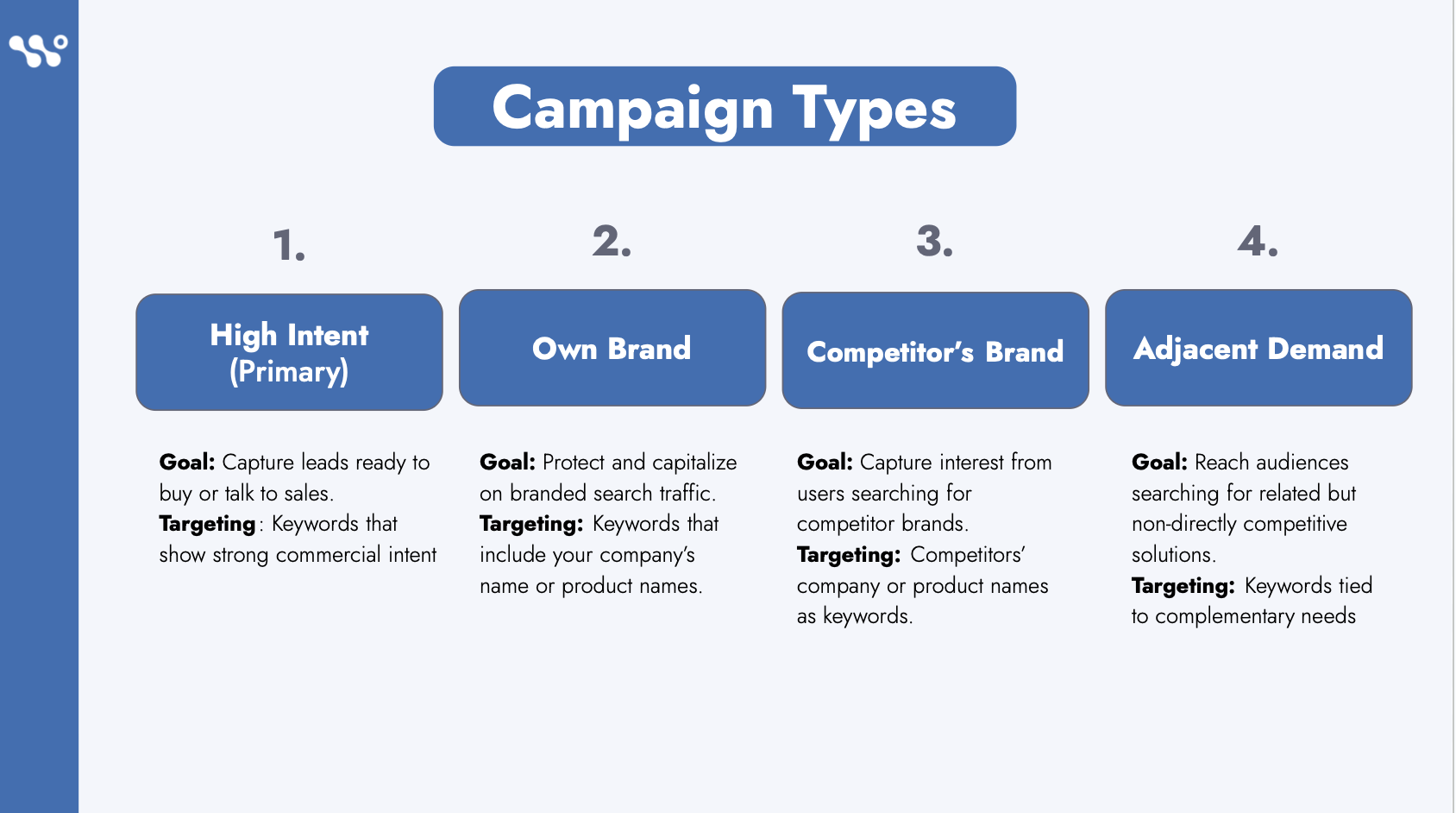
Campaign Types
The following campaign types are how we recommend B2B business structure their Google Ads, based on each company's needs & offerings.
High Intent
For B2B brands, a high-intent campaign is the foundation of an effective Google Ads strategy, designed to capture prospects who are actively searching for your category and ready to engage with sales.
These campaigns focus on non-branded, commercial-intent keywords that signal a clear need for your product or service, making them both highly competitive and often the most expensive in your mix. Because Google offers limited visibility into who the searcher actually is, success comes down to thoughtful keyword selection, ongoing testing, and tightly controlled budgets at the campaign level.
For most mature B2B categories with established search volume, this is the campaign type we recommend launching first: it puts your brand directly in front of buyers already searching your solution, before they’ve chosen a vendor.
Bidding for Your Brand
Branded search campaigns sit in a unique place for B2B companies, not always essential, but often more important than teams realize.
Many advertisers end up bidding on their own brand unintentionally, simply because Google’s algorithm favors high-converting terms and will shift budget toward branded queries unless they’re explicitly excluded. A dedicated branded campaign gives you budget control, protects visibility when competitors target your name, and ensures you hold the top spot for buyers already looking for you.
The real question to explore when deciding if branded bidding is “right” or “wrong” for you is whether or not it will bring in revenue you wouldn’t have captured organically.
For brands with strong awareness or active competitor pressure, a small, tightly optimized branded campaign can be a highly cost-effective defensive play. For younger brands with little competitive overlap, that budget may be better spent elsewhere.
Bidding for Competitors Brand
Google will often match your ads to competitor searches by default due to its semantic understanding of category relationships. Isolating competitor keywords into their own campaign lets you control spend, set realistic expectations, and craft messaging that highlights how you differ without directly naming rivals in the ad copy.
Because prospects searching for a competitor already have a brand in mind, performance here will never match your own branded or generic high-intent terms. Instead, think of competitor campaigns as a brand awareness play: a way to show up alongside the “1,000-pound gorillas” in your space, much like placing a billboard outside your competitor’s conference booth.
When used thoughtfully, they can carve out consideration you wouldn’t otherwise earn, but they should be measured by visibility and engagement, not conversions.
Adjacent Demand
Adjacent demand campaigns extend your reach beyond bottom-of-funnel, high-intent searches and into the surrounding needs, questions, or upstream signals that often precede a purchase.
These campaigns target audiences who aren’t actively searching for your exact solution yet but are exploring related topics, complementary tools, or early-stage considerations that indicate future intent. While performance metrics will naturally dip, lower conversion rates, higher costs, and a softer signal of buying readiness, adjacent demand can be valuable when organic visibility is limited or when you have strong educational content that converts well through nurturing.
Think of it as diverting a small stream from the main river of category demand: not every B2B company will have meaningful adjacencies to target, but for those that do, these campaigns can help you reach buyers earlier, build brand affinity, and expand the pool of future in-market leads.
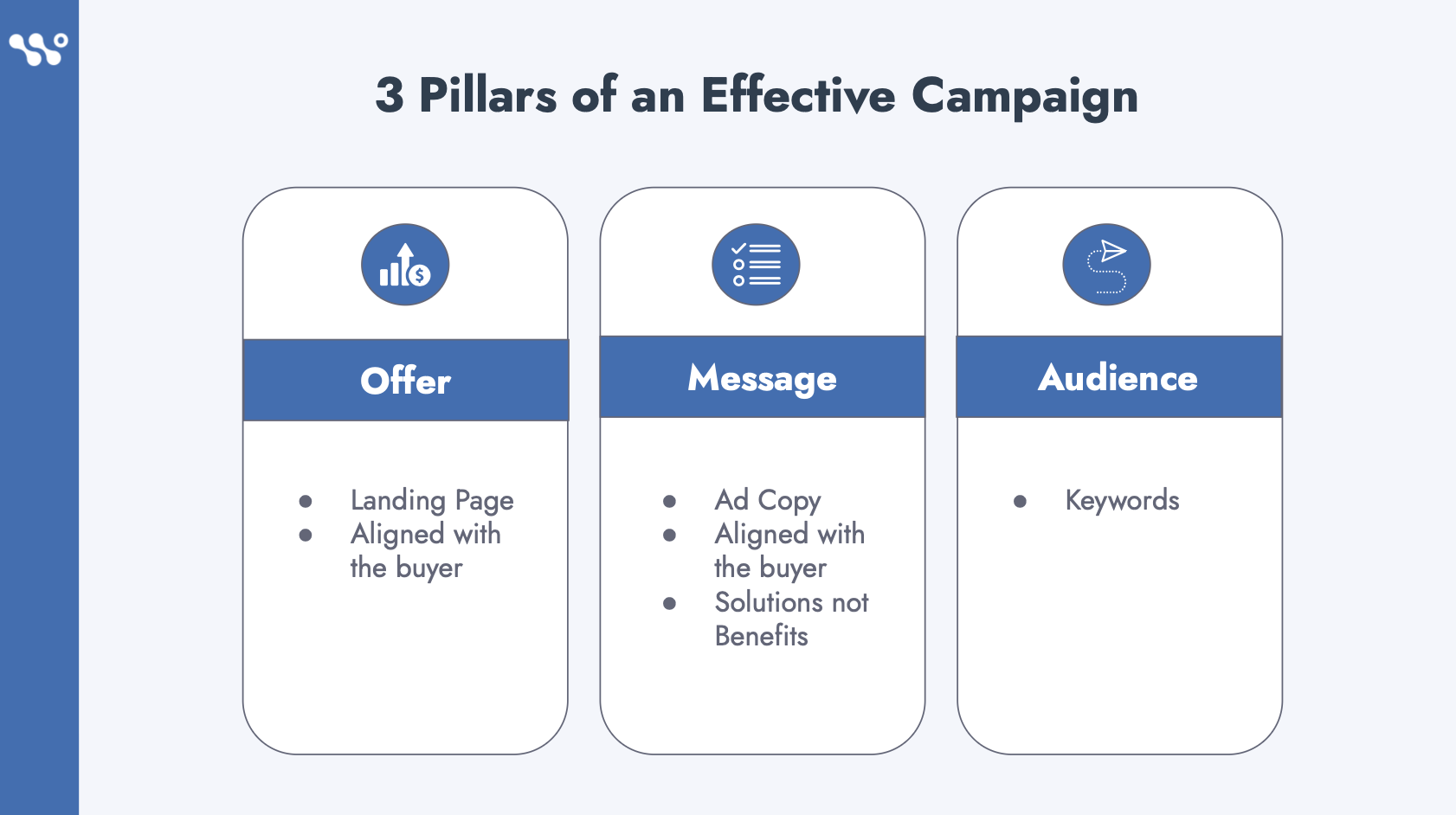
The Three Pillars of an Effective Campaign
Offer
At the heart of every effective Google Ads campaign is an offer that matches the searcher’s intent. Whether a user is looking for a generic solution, your specific brand, or even a competitor, the landing experience must align with what they came for.
In B2B, this alignment is even more critical: a high-intent search requires a direct next step, while early-stage or comparative searches call for education and differentiation. When possible, personalization elevates performance even further, helping prospects feel understood and pulling them naturally toward the next stage of the funnel.
Message
Your message serves as the bridge between the search query and the offer. Its primary job is capturing attention and creating enough intrigue for the user to click.
Strong copy, thoughtful callouts, and effective use of extensions all work together to communicate relevance in a text-only environment. But the message must deliver on its promise once the user arrives on your landing page.
If the ad captures attention but the offer doesn’t match the intent, performance suffers and Google will quickly penalize the misalignment with higher costs.
Keywords
For B2B, where intent signals are subtle and volume is low, selecting the right keywords, and grouping them strategically, is essential. Your keywords dictate who sees your message, how well your offer matches their intent, and ultimately how efficiently your budget performs.
Early in a campaign, it’s best to start with a few tightly themed keyword groups that allow for testing across ads and landing pages. As data accumulates, high-performing terms can be isolated into more refined experiences, improving relevance, lowering acquisition costs, and strengthening the campaign’s overall effectiveness.
Tips for Ongoing Optimization
Launching a B2B Google Ads campaign is only the beginning, quality performance comes from continuous optimization.
Begin by monitoring search terms frequently to protect the integrity of your audience and eliminate low-quality traffic by adding in negative keywords.
From there, evaluate engagement quality by testing headlines, descriptions, and extensions to improve click-through rates and your message to intent match.
Finally, dig into conversion quality by studying how users interact with your landing pages: analyze sessions, ensure fast loading, check device behavior, and refine form experiences to balance friction with the information your sales team needs.
When you optimize in this order, impressions, engagement, conversions, each improvement compounds the next. And if you need support turning insights into stronger pipeline, the Boundify team is always here to help.
Interested in learning more? Check out the rest of the episodes of Demand Gen Studio. We discuss marketing and demand generation topics, with inspiring interviews with thought leaders. See you next time!
For a real-world example, see how Boundify helped a commercial real estate company with content.